
Learn on the student’s own history.
Generate on-policy autoregressive rollouts, exposing training to the contexts the student encounters at inference.
Long-horizon video generation & world modeling
Distilling History-Dependent Continuations
for Long-Horizon Video World Models
1 Zhejiang University2 Microsoft Research3 Monash University4 Adelaide University
News · 2026-11-03 Our paper, model checkpoints and datasets are now available.
Remember what came before. Generate what comes next.
Few-step autoregressive video diffusion enables efficient generation, yet maintaining consistency over long rollouts remains challenging, especially when subjects or scenes reappear after going out of sight. Despite progress in fidelity and rollout robustness, existing distillation methods do not fully exploit richer historical information to constrain the student's current prediction. To address this gap, we introduce History Forcing, a unified on-policy distillation framework that strengthens historical supervision for few-step autoregressive video generators. The framework uses the residual between teacher predictions with and without informative historical context to decouple this supervision. Such a historical context can be obtained using earlier generated chunks with less accumulated drift or a fixed-view teacher rollout that keeps the scene visible while the student looks away. The residual is then weighted and added to the score or velocity prediction used for distillation, forming a corrected target. By aligning the student with this corrected target through distillation, History Forcing incorporates long-range historical constraints into autoregressive generation. Our method achieves state-of-the-art performance among 1.3B models, with a VBench quality score of 85.07 for 15s video generation and a VBench-Long aggregate score of 79.82 for 60s generation. For out-of-sight world modeling, evaluations further demonstrate more plausible scene evolution and more consistent states when the camera returns, with Evolution Quality improving from 2.35 to 2.70 on PlayWorld and Object Consistency from 58.43 to 62.18 on MemoBench.
01 Long-video generation
Explore extended rollouts across human motion, everyday activities, and fine-grained interactions.
Select 2× or 4× playback to follow how each scene develops over the full rollout. Expand “View prompt” to see the original text input.
02 Side-by-side comparison
Compare 15-second generations with synchronized playback. Watch how appearance and scene structure change over time.
03 Out-of-sight world modeling
The camera leaves, the scene evolves, and then the camera returns. Historical supervision helps preserve objects and guide plausible state changes.
Camera-controlled comparisons use DreamX-World-5B. Left: baseline. Right: History Forcing with historical supervision (λ = 3).
04 Method
A unified training principle connects long-horizon consistency with out-of-sight evolution.
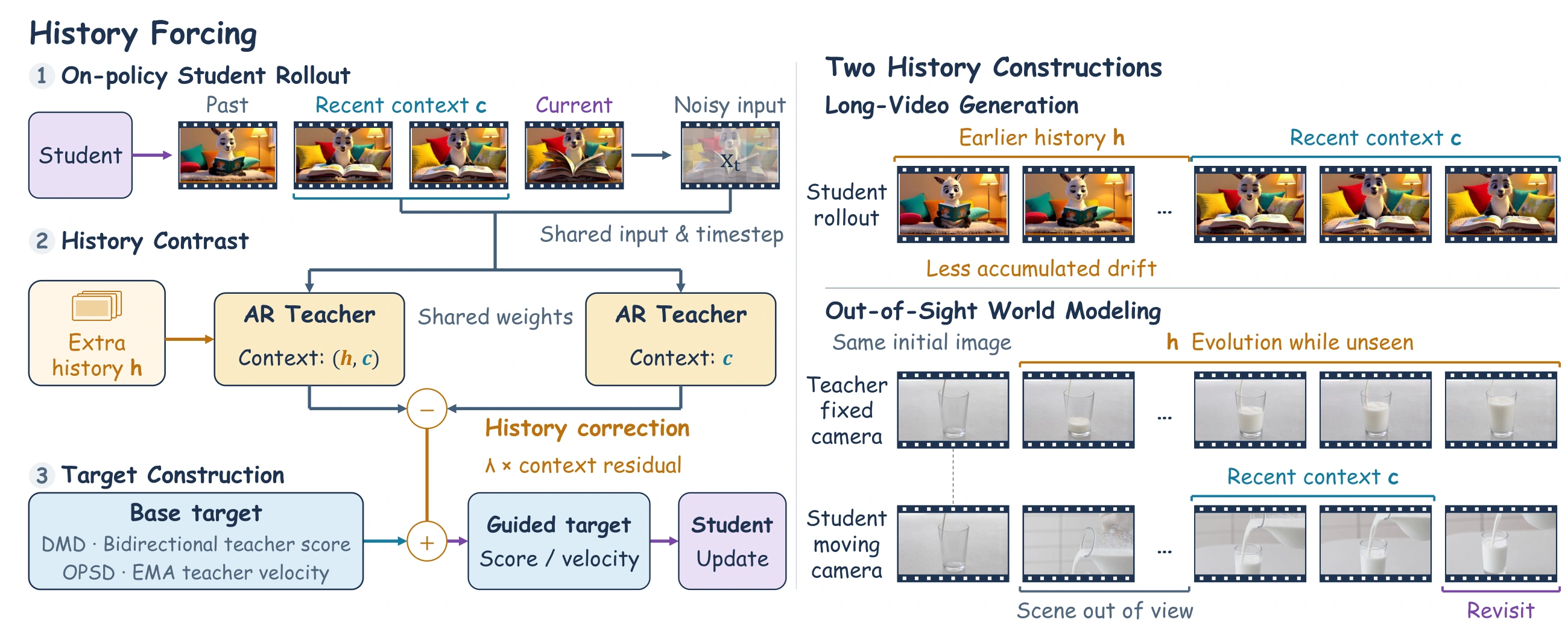
Generate on-policy autoregressive rollouts, exposing training to the contexts the student encounters at inference.
Hold the noisy chunk, timestep, and recent context fixed. Compare teacher predictions with and without additional informative history.
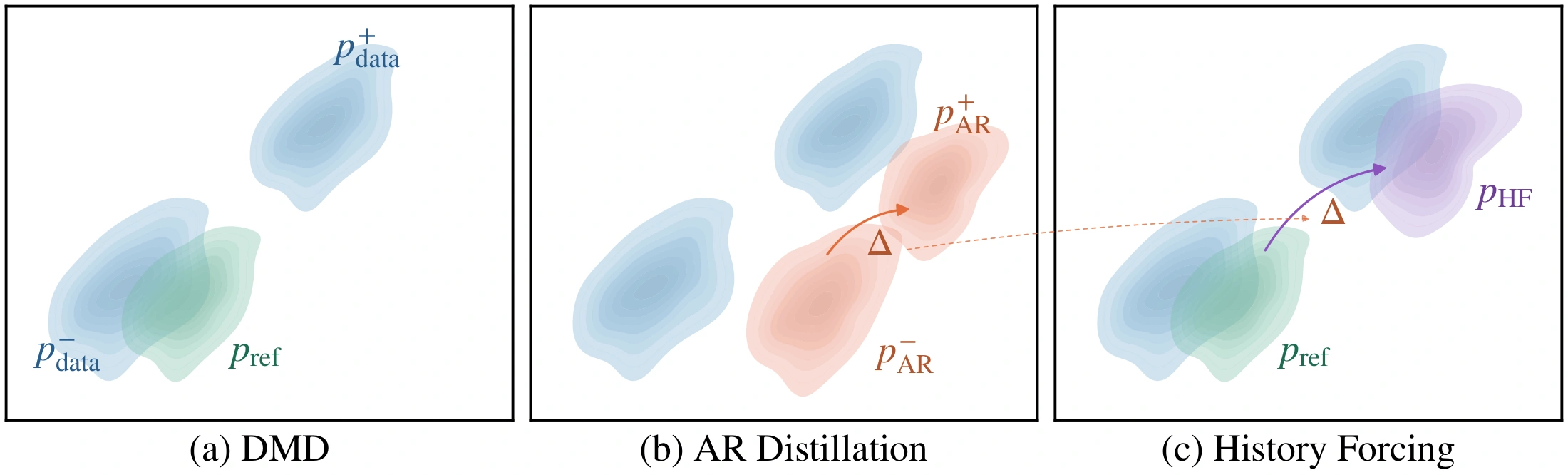
Add the weighted history residual to the DMD reference score or the EMA teacher’s velocity target, then distill the corrected target into the student.
One principle, two applications
For long videos, earlier student-generated chunks correct the DMD reference score while retaining bidirectional supervision for visual quality. For world models, fixed-camera teacher history guides velocity predictions when the student revisits the scene.
05 Results
Leading quality and aggregate scores among the compared 1.3B video models, with improved camera-controlled revisits.
| Method | Student | DMD teacher | Aggregate ↑ | Subject ↑ | Background ↑ |
|---|---|---|---|---|---|
| Causal Forcing | 1.3B | 14B | 76.43 | 93.52 | 94.12 |
| SkyReels-V2 | 1.3B | — | 74.80 | 84.99 | 89.95 |
| Self-Forcing | 1.3B | 14B | 77.73 | 95.84 | 95.27 |
| CausVid | 1.3B | 1.3B | 76.85 | 86.75 | 89.85 |
| Rolling Forcing | 1.3B | 14B | 79.22 | 94.09 | 94.47 |
| LongLive | 1.3B | 14B | 79.12 | 97.13 | 95.89 |
| History Forcing Ours | 1.3B | 1.3B | 79.82 | 97.32 | 96.19 |
| LongLive-2.0 (larger model) | 5B | 5B | 79.90 | 97.48 | 97.00 |
Best results highlighted within the 1.3B group. Competing 60s results are taken from LongLive-2.0, as reported in the paper. History Forcing uses student training rollouts of at most 15s.
| Method | Quality ↑ | Subject ↑ | Background ↑ |
|---|---|---|---|
| CausVid | 82.68 | 92.16 | 92.43 |
| Self-Forcing | 83.70 | 92.46 | 93.97 |
| LongLive | 84.20 | 94.15 | 95.75 |
| Rolling Forcing | 84.20 | 95.61 | 95.80 |
| Infinity-RoPE | 84.54 | 92.64 | 95.52 |
| Context Forcing | 83.76 | 94.20 | 95.33 |
| DMD baseline | 84.44 | 91.84 | 93.58 |
| History Forcing · 5s teacher | 84.82 | 92.58 | 93.91 |
| History Forcing · 10s teacher | 85.07 | 93.21 | 95.03 |
Selected metrics from the paper’s 15s VBench comparison. History Forcing achieves the highest quality score.
| Benchmark / metric | Baseline | OPSD-V | History Forcing |
|---|---|---|---|
| PlayWorld Out-of-sight · ratings on a 1–5 scale | |||
| Raw mean ↑ | 2.38 | 2.44 | 2.69 |
| Gated mean ↑ | 2.29 | 2.37 | 2.49 |
| Evolution quality ↑ | 2.35 | 2.42 | 2.70 |
| Subject identity ↑ | 2.70 | 2.72 | 2.98 |
| MemoBench Real · selected metrics | |||
| Object consistency ↑ | 58.43 | 59.73 | 62.18 |
| 3D consistency ↑ | 84.35 | 84.51 | 86.22 |
| Motion smoothness ↑ | 64.03 | 65.71 | 66.56 |
| LPIPS ↓ | 0.5703 | 0.5674 | 0.5558 |
Baseline: DreamX-World-5B. OPSD-V is adapted with fixed-view history (λ = 1); History Forcing uses λ = 3. Selected MemoBench metrics are shown.
@article{kuang2026historyforcing,
  title={History Forcing: Distilling History-Dependent Continuations for Long-Horizon Video World Models},
  author={Kuang, Hangyi and Wang, Chengzhi and He, Yefei and Wang, Weijie and Zhao, Yuke and Chen, Zhuokun and Huang, Zisu and Yang, Yifan and He, Xiaoxuan and Chen, Feng and Zhuang, Bohan},
  journal={arXiv preprint arXiv:2611.02782},
  year={2026}
}